Rapier:Equipment standards - Metal bladed weapons: Difference between revisions
Jump to navigation
Jump to search
Approved for commentary 18 November 2025 |
updated with the approval of the Rapier and Cut and Thrust Handbooks 23 June 2026 Tag: Manual revert |
| (One intermediate revision by the same user not shown) | |
(No difference)
| |
Latest revision as of 22:30, 8 July 2026
Equipment standards - Metal bladed weapons
General
- Metal bladed weapons include daggers, single-handed swords, and two-handed swords.
- Weapons must be maintained in good order, with no loose pieces, excessive rust, and no burrs on metal or wooden edges that can snag body or clothing.
- Bladed weapons must not have more than one blade.
- Blades can only have at most one substantial curve.
- If the blade of a weapon is so curved that the tip does not contact the ground when the grip is perpendicular to the ground (i.e. pointed vertically), it is not allowed. Although examples of blades with extreme curves can be found in period, these swords require highly different mechanics than the swords intended for use by these rules. (See Figure 13.1)
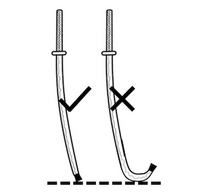
Figure 13.1. Excessively curved blades. With the grip vertical, the tip must touch the ground. In this example, the sword on the left is allowed, the sword on the right is not. - You are allowed to use a non-metal version as a defensive object.
- If a weapon has multiple small waves about a singular axis, such as a flamberge, it is considered based on its main axis; i.e. each wave is not necessarily a "substantial curve".
- If the blade of a weapon is so curved that the tip does not contact the ground when the grip is perpendicular to the ground (i.e. pointed vertically), it is not allowed. Although examples of blades with extreme curves can be found in period, these swords require highly different mechanics than the swords intended for use by these rules. (See Figure 13.1)
- The length of a blade and grip define the type of weapon. (See Table 13.1 and Figure 13.2.)
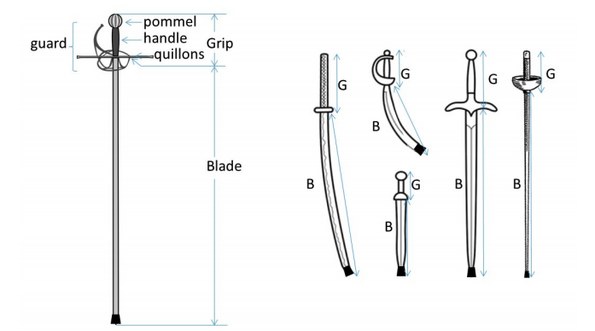
Figure 13.2. Parts of a weapon, and the measurements of blade (B) and grip (G) - Blade length is measured from the base of the blade (i.e. the front face of the guard, or the front end of the quillons for open guard) to the end of the tip. See Figure 13.2.
- Curved blade length is measured as a straight line from the tip to the base of the blade. (Length is specified by the reach of the weapon).
- Highly curved blades that skirt the spirit of the length-reach rules pose potential issues with an exceedingly long aspect ratio, and at the marshal's discretion it may not be allowed.
- Grip length (measured from the bottom of the pommel to the base of the blade) makes up the remainder of the overall weapon length.
- Blade length is measured from the base of the blade (i.e. the front face of the guard, or the front end of the quillons for open guard) to the end of the tip. See Figure 13.2.
- A weapon must not be longer than the total weapon length specified in Table 13.1 and in reference to Figure 13.2.
- The Kingdom Deputy for this discipline is allowed to make exceptions to the blade length and grip length ratios on a case-by-case basis.
- For example, a weapon with a grip of 11 inches (280 mm) could be allowed. If the total length is between 28 inches (710 mmm) and 60 inches (1520 mm), that weapon counts as a sword, if it is shorter, it counts as a dagger.
- A weapon must not be longer than the total length allowed for a weapon of its type.
- No marshal can allow weapons longer than 60 inches (1520 mm).


| Overall weapon length (W) | Blade length (B) | Grip length (G) | |
|---|---|---|---|
| Dagger | ≤ 28 inches
(≤ 710 mm) |
≤ 18 inches
(≤450 mm) |
≤ 10 inches
(≤ 250 mm) |
| Single-handed sword | ≤ 58 inches
(≤ 1470 mm) |
>18 inches (450 mm) and
≤ 48 inches (1220 mm) |
≤ 10 inches
(≤ 250 mm) |
| Two-handed sword | ≤ 60 inches
(≤ 1520 mm) |
>30 inches (760 mm) and
≤ 48 inches (1220 mm) |
> 10 inches (250 mm)
≤ 24 inches (610 mm) |
Blades
- The blade must be made of steel and must be produced by a commercial entity and crafted for the purpose of competitive sword fighting.
- No foils, epees, flexi-daggers, or similar blades are allowed.
- Any blade with kinks or cracks must not be used.
- If a blade develops these defects and cannot be repaired, it must be retired.
- If a blade develops a sharp bend that can be re-curved and not redevelop for at least a day's use, it can continue to be used.
- A blade must not be altered by grinding, cutting, heating, hammering, or other actions that could significantly alter the blade's temper, flexibility or durability.
- Normal combat stresses and blade care do not violate this rule.
- The following alterations are allowed:
- Altering the tang of the weapon
- Shortening a blade as long as it still meets the required flexibility
- Welding a nut or other blunt metal object designed to spread impact to the tip of a blade, so long as care is taken to prevent damage to the temper of the blade
- Filing the end of a blade to blunt the tip, or filing other parts of the blade to remove burrs
- A blade must meet or exceed the required flexibility.
- The marshal will test flexibility by securing the hilt so the blade is horizonal, placing a 6 oz (170 g) weight at the tip, and then measuring how far the tip of the blade has moved downward.
- Any flexing due to the blade's weight itself is not counted in the flexibility standard.
- The blade must meet this standard in each of two directions (i.e. testing the flexibility of the blade along its flatter dimension, then turn the sword over, 180 degrees, and testing it again.)
- Dagger blades must flex at least 1/2 inch (12.5 mm).
- Single sword and two-handed sword blades must flex at least 1 inch (25 mm).
Hilts, handles, pommels, and other parts
- Hilts, handles, pommels, and other parts of a weapon not meant to strike an opponent can be made of metal, wood, leather, or a reasonable facsimile.
- Handles must be substantially straight, and substantially in line with the main axis of the blade.
- The ends of quillons must be blunt (no sharp edges, corners, or points).
Tips
- The end of a blade must be blunt (no sharp edges, corners, or points).
- A blade must have a tip cover of rubber, shatter-resistant polymer, or leather with a minimum size in any direction that strikes your opponent of 3/8 inch (10 mm). Shatter-resistant polymer includes many flexible 3-D printed materials.
- A rubber or polymer tip must have a minimum of 1/8 inch (3 mm) between the striking surface and the tip or edge of the sword.
- Leather must be at least 1.6 mm / 1/16 inch / 4 oz thick
- The tip cover must be secured to prevent it from being dislodged in typical combat.
- The tip cover must be taped (or equivalent) in a contrasting color to the tip and blade that extends both onto the tip and onto the blade. The purpose of the contrast is to provide a visual indicator if the tip cover is lost during combat.
- For tips built in a period style, a period alternate to tape may be used, so long as it provides a contrasting color to the blade and the tip and the combination is secured on the sword so that it will not come off under reasonable fighting conditions.
- Tape used to secure the tip cover or for contrasting color should be somewhat resistant to impact with metal, and its adhesive must adhere to rubber and metal.
- Fabric hockey tape, fiber-reinforced duct tape, electrical tape, and colored strapping tape are examples of good tapes for this application. Painters tape, masking tape, and other paper based tapes are not.
- Tapes must be of good quality and able to withstand the local climate. Kingdoms should consider specific requirements due to climate and commonly available types of tape in their area.
- If you travel to an area with a different climate than you usually participate in, be aware that your tip tape may behave differently.
- The front surface of the tip cover must not be covered to enable inspection.
- The tip cover must be replaced if it shows evidence of punch through, cracking or bulging or, in the case of polymer tips, discoloration.