Rapier:Equipment standards - Metal bladed weapons - General
Jump to navigation
Jump to search
General
- Metal bladed weapons include daggers, single-handed swords, and two-handed swords.
- Weapons must be maintained in good order, with no loose pieces, excessive rust, and no burrs on metal or wooden edges that can snag body or clothing.
- Bladed weapons must not have more than one blade.
- Blades can only have at most one substantial curve.
- If the blade of a weapon is so curved that the tip does not contact the ground when the grip is perpendicular to the ground (i.e. pointed vertically), it is not allowed. Although examples of blades with extreme curves can be found in period, these swords require highly different mechanics than the swords intended for use by these rules. (See Figure 13.1)
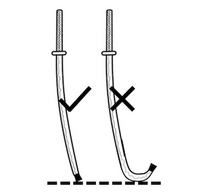
Figure 13.1. Excessively curved blades. With the grip vertical, the tip must touch the ground. In this example, the sword on the left is allowed, the sword on the right is not. - You are allowed to use a non-metal version as a defensive object.
- If a weapon has multiple small waves about a singular axis, such as a flamberge, it is considered based on its main axis; i.e. each wave is not necessarily a "substantial curve".
- If the blade of a weapon is so curved that the tip does not contact the ground when the grip is perpendicular to the ground (i.e. pointed vertically), it is not allowed. Although examples of blades with extreme curves can be found in period, these swords require highly different mechanics than the swords intended for use by these rules. (See Figure 13.1)
- The length of a blade and grip define the type of weapon. (See Table 13.1 and Figure 13.2.)
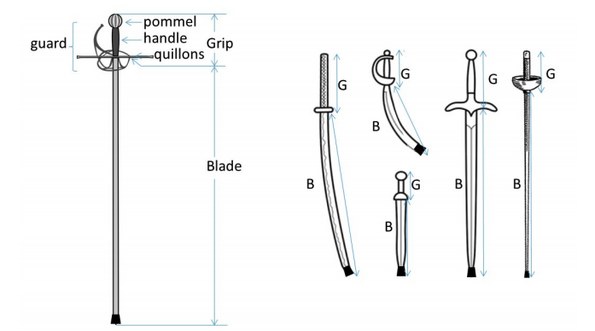
Figure 13.2. Parts of a weapon, and the measurements of blade (B) and grip (G) - Blade length is measured from the base of the blade (i.e. the front face of the guard, or the front end of the quillons for open guard) to the end of the tip. See Figure 13.2.
- Curved blade length is measured as a straight line from the tip to the base of the blade. (Length is specified by the reach of the weapon).
- Highly curved blades that skirt the spirit of the length-reach rules pose potential issues with an exceedingly long aspect ratio, and at the marshal's discretion it may not be allowed.
- Grip length (measured from the bottom of the pommel to the base of the blade) makes up the remainder of the overall weapon length.
- Blade length is measured from the base of the blade (i.e. the front face of the guard, or the front end of the quillons for open guard) to the end of the tip. See Figure 13.2.
- A weapon must not be longer than the total weapon length specified in Table 13.1 and in reference to Figure 13.2.
- The Kingdom Deputy for this discipline is allowed to make exceptions to the blade length and grip length ratios on a case-by-case basis.
- For example, a weapon with a grip of 11 inches (280 mm) could be allowed. If the total length is between 28 inches (710 mmm) and 60 inches (1520 mm), that weapon counts as a sword, if it is shorter, it counts as a dagger.
- A weapon must not be longer than the total length allowed for a weapon of its type.
- No marshal can allow weapons longer than 60 inches (1520 mm).


| Overall weapon length (W) | Blade length (B) | Grip length (G) | |
|---|---|---|---|
| Dagger | ≤ 28 inches
(≤ 710 mm) |
≤ 18 inches
(≤450 mm) |
≤ 10 inches
(≤ 250 mm) |
| Single-handed sword | ≤ 58 inches
(≤ 1470 mm) |
>18 inches (450 mm) and
≤ 48 inches (1220 mm) |
≤ 10 inches
(≤ 250 mm) |
| Two-handed sword | ≤ 60 inches
(≤ 1520 mm) |
>30 inches (760 mm) and
≤ 48 inches (1220 mm) |
> 10 inches (250 mm)
≤ 24 inches (610 mm) |