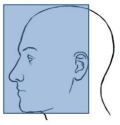
Your face and sides of your head up to and including a vertical line drawn at the back of your external ear are to be covered by a 12kg fencing mask or equivalent head protection. Figure 12.2. The head and face, indicated here, must be protected by a 12 kg mask or equivalent.Figure 12.2 illustrates the portion of your face and head that must be protected by rigid material.
Your mask or helm must extend down past your chin so that your mask or helm and neck armor together do not leave a significant gap in the rigid protection that protects against typical thrusts coming from the front.
Your mask or helm must be secured, so that it cannot be easily removed or dislodged during combat.
All parts of your fencing mask or helm that might cause injurious contact with your head must be padded or be suspended in such a way as to prevent contact during combat.
There must be no major internal projections
Minor projections of necessary structural components must be padded.
All metal must be free of sharp edges.
Back of head
The rest of your head, aside from your face as defined above, must be covered by abrasion resistant material.
Fencing masks
The interior of your fencing mask must have at least 1/4 inch (6 mm) open-cell foam or equivalent resilient padding to create separation between the mask and your face. Modern fencing masks (e.g. FIE and USFA type masks) in good working order meet this requirement without additional padding.
Your mask must be secured by a combination of the tongue/spring and the elastic back strap in good repair, or by the tongue/spring and other means such as a tie strap.
Helms
The metals listed under rigid armor are considered equivalent to a 12 kg fencing mask mesh.
If your helm uses a suspension system, it must prevent any rigid parts of your helm from contacting your head. At least 1/4 inch (6 mm) of open cell foam or equivalent resilient material may be used to meet this requirement.
If your helm does not have a suspension system and relies on foam, it must have at least 1/4 inch (6 mm) of closed-cell foam or equivalent resilient padding which provides progressive resistance to create separation between you and the hard outer shell of the helm.
If you have a movable visor, it must be attached and secured in such a way that there is minimal chance that it will become detached or come open in normal combat use.
Neck
Figure 12.3. The parts of the neck shown here shaded must be covered by rigid protection. The double headed arrow indicates that the back of the neck to a total minimum width of 5 inches (125 mm) centered on the vertebrae must be covered.
The entire front 180 degrees of your neck, and at least 5 inches (125 mm) centered on your cervical vertebrae, must be covered by rigid material.
Gaps in rigid material at the sides beyond the front 180 degrees are allowed, but must be covered by puncture resistant material.