If you are a combatant on the field during combat activities, you must wear armor that meets or exceeds the minimum standards set in this handbook, and any additional armor requirements of the kingdom you are in.
It is your responsibility to decide if you want to wear any additional armor beyond the minimum standards required, to reduce the risk of combat to an acceptable level to you.
The areas required to be armored must stay protected during typical movements that you will make during combat.
Your armor must be fastened in a way that prevents it from being dislodged in normal use.
All metal must be free of sharp edges.
You should disguise, cover, or remove modern corporate logos and sport gear unless the gear is necessary for medical reasons. We are trying to maintain the historical atmosphere.
If you have any body-worn medical equipment, you must cover it in such a way that it is protected against blows or the possibility of you falling on it if such an impact could damage it or cause injury.
Summary of areas to be armored
Figure 12.1. Single-handed weapons and spears: Areas of the body that must be armored, by type of armor.Figure 12.2. Two-handed metal weapons: Areas of the body that must be armored, by type of armor.
Areas of your body which must be armored:
Your entire head (face, sides, and back), and your neck (throat and cervical vertebrae) - rigid material.
The back of your hands, fingers and wrists - padding (for single handed weapons and spears) or rigid material (for two-handed metal weapons).
Your torso, including the inner arm down to 4 inches (100 mm) below the armpit, and your groin area - puncture resistant material.
If you have testicles - rigid material.
Figure 12.1 illustrates the areas of your body that must be protected by rigid material, penetration resistant material, or resilient padding when combatants are only wielding single-handed weapons and spears.
Figure 12.2 illustrates the areas of your body that must be protected by rigid material, penetration resistant material, or resilient padding when any combatant is wielding two-handed metal weapons.
Types of armor
There are four types of armor providing different levels of protection:
Rigid
Penetration resistant
Abrasion resistant
Resilient padding
Rigid
Material that will not significantly flex, spread apart, or deform under pressure of 12 kg applied by a standard mask tester, repeatedly to any single point.
Examples of rigid material are:
22 gauge stainless steel (0.8 mm)
20 gauge mild steel (1.0 mm)
16 gauge aluminum, copper, or brass (1.6 mm)
One layer of hardened heavy leather (8 ounce, 3.2 mm)
12 kg fencing mask mesh
High-impact-resistant plastics such as ABS or polyethylene of sufficient thickness to give similar rigidity to those listed above (e.g. modern HEMA style synthetic back of head protection)
Modern rigid athletic cup
Perforated material that meets this requirement must have holes no larger than 1/8 inch (3 mm) in any direction, and a spacing of at least 3/16 inch (5 mm) center-to-center. In using these measurements, the perforated material must meet all the requirements of either the imperial or the metric units (or both).
Penetration resistant
Material that will predictably withstand puncture as demonstrated by passing a penetration test.
The following materials are known to pass these tests when new, but may be tested at the marshal's discretion;
4 ounce (1.6 mm) leather
Four layers of heavy poplin cloth (35% cotton, 65% polyester; "trigger" cloth)
Ballistic nylon rated to at least 550 Newtons
Commercial fencing clothing rated to at least 550 Newtons
Chain mail made of welded or riveted steel rings that will not admit a 5/32 inch (4 mm) diameter probe. Rings no greater than 5/32 inch (4 mm) in internal diameter made of wire no less than 2/100 inch (0.5 mm) thick meets this requirement.
All other materials must be tested the first time new gear is used, or if no marshal on the field knows a given piece of gear to have been tested.
Penetration resistant armor (except chain mail) must be drop-tested at least every two years (see Inspecting equipment)
Penetration resistant armor may be tested at any time at the marshal's discretion using the drop tester. (see Inspecting equipment)
Chain mail armor meeting the definition of penetration resistant must not have more than one adjacent missing link. Missing links must be replaced before the armor is worn. Split rings with at least two full turns are acceptable replacement links.
Excessively stretchy materials (e.g. UnderArmour, Spandex) are not suitable as puncture resistant materials and must not be included in the armor being testing.
Abrasion resistant
Material that will withstand normal combat stresses (such as being snagged by a burr on a metal blade) without tearing.
Examples include, but are not limited to:
Broadcloth
A single layer of heavy poplin cloth (35% cotton, 65% polyester; "trigger" cloth)
Sweat pants
Opaque cotton, poly-cotton or lycra/spandex mix tights
Nylon pantyhose and cotton gauze shirts are examples of unacceptable materials.
Resilient padding
Material which compresses under pressure from a thumb but returns to its shape within three seconds once pressure is removed.
Armor requirements for each area of the body
Head
Face and sides
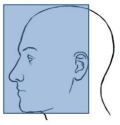
Your face and sides of your head up to and including a vertical line drawn at the back of your external ear are to be covered by a 12kg fencing mask or equivalent head protection. Figure 12.3. The head and face, indicated here, must be protected by a 12 kg mask or equivalent.Figure 12.3 illustrates the portion of your face and head that must be protected by rigid material.
Your mask or helm must extend down past your chin so that your mask or helm and neck armor together do not leave a significant gap in the rigid protection that protects against typical thrusts coming from the front.
Your mask or helm must be secured, so that it cannot be easily removed or dislodged during combat.
All parts of your fencing mask or helm that might cause injurious contact with your head must be padded or be suspended in such a way as to prevent contact during combat.
There must be no major internal projections.
Minor projections of necessary structural components must be padded.
All metal must be free of sharp edges.
Back of head
The rest of your head must be covered by rigid material to protect against percussive blows.
Gaps in the rigid material are allowed, but must protect against percussive blows and be covered by abrasion resistant material.
Fencing masks
The interior of your fencing mask must have at least 1/4 inch (6 mm) open-cell foam or equivalent resilient padding to create separation between the mask and your face. Modern fencing masks (e.g. FIE and USFA type masks) in good working order meet this requirement without additional padding.
Your mask must be secured by a combination of the tongue/spring and the elastic back strap in good repair, or by the tongue/spring and other means such as a tie strap.
Helms
The metals listed under rigid armor are considered equivalent to a 12 kg fencing mask mesh.
If your helm uses a suspension system, it must prevent any rigid parts of your helm from contacting your head. At least 1/4 inch (6 mm) of open cell foam or equivalent resilient material may be used to meet this requirement.
If your helm does not have a suspension system and relies on foam, it must have at least 1/4 inch (6.4 mm) of closed-cell foam or equivalent resilient padding which provides progressive resistance to create separation between you and the hard outer shell of the helm.
If you have a movable visor, it must be attached and secured in such a way that there is minimal chance that it will become detached or come open in normal combat use.
Neck
Figure 12.4. The parts of the neck shown here shaded must be covered by rigid protection. The double headed arrow indicates that the back of the neck to a total minimum width of 5 inches (125 mm) centered on the vertebrae must be covered.
The entire front 180 degrees of your neck, and at least 5 inches (125 mm) centered on your cervical vertebrae, must be covered by rigid material.
Gaps in rigid material at the sides beyond the front 180 degrees are allowed, but must be covered by penetration resistant material.
Body and groin armor
Your torso, including the abdomen down to and including the groin in front, and the inner arm down to 4 inches (100 mm) below the armpit, must be covered by penetration resistant material.
The inner thigh extending 4 inches (100 mm) down from the groin is not required to be covered by penetration resistant material.
If you have testicles, they must be protected by groin protection equivalent to that provided by an athletic cup, secured by straps, or worn in a supporter or garment designed to hold the protection in place.
Hand and wrist armor
The backs of the hands, including fingers and 1 inch (25 mm) above the bend of the wrist, must be covered by 1/4 inch (6 mm) open cell foam or equivalent resilient padding.
If two-handed metal weapon(s) are in use, then all combatants must cover the backs of hands, including fingers and 1 inch (25 mm) above the bend of the wrist on the back half of the forearm, with rigid material.
Rigid protection must have sufficient coverage to prevent a reasonable percussive blow from contacting the bones of the hand and wrist.
The rigid protection does not require padding underneath.
The coverage for rigid protection may be achieved by any combination of gauntlet, sword guard, or defensive object. A shield alone may be considered an equivalent to full hand and wrist protection only if no part of the gloved hand or wrist is within 4 inches (100 mm) of the edge of the shield while the shield is in use.
Arm armor
The inner arm down to 4 inches (100 mm) below the armpit must be covered by penetration resistant material. The rest of the arm (except elbow) is not required to be covered.
The point of your elbow and the bones at either side of your elbow joint must be covered by a minimum of a resilient padding at least 1/8 inch (3 mm) thick.
Leg armor
Legs and feet are not required to be covered.
Footwear that provides adequate protection and support for the terrain and activity of combat is recommended.
Protective gear for marshals
If you are on the field, such as supervising combat, heralding etc., when missile weapons are present (e.g. combat archery, rubber band guns) you must wear eye protection which is sufficient to protect against the missiles in use. Examples include:
Industrial or sports safety glasses or goggles meeting the ANSI Z87.1 standard or better,
A fencing mask,
A helm that meets the standards for this form of combat.